


Pew Research Center surveyed nearly 1,400 U.S. teenagers in late 2024 and found that 16% of them are on TikTok “almost constantly.” Among Black teens, the figure was 28%. Among Hispanic teens, 25%. Roughly six in ten U.S. teens use the app, and most log in daily.
If you’re a parent watching your teen reach for their phone the moment they have a free second, those numbers won’t surprise you. What might surprise you is what the U.S. Surgeon General’s office and the American Academy of Pediatrics have started saying about why those numbers matter — and what they want parents to actually do about it.
“Almost Constantly” — What the Data Says
The clearest snapshot of teen TikTok use comes from Pew Research’s Teens, Social Media and Technology 2024 report, based on a survey of 1,391 U.S. teens ages 13 to 17 conducted September 18 to October 10, 2024.
16% Of U.S. teens (ages 13–17) say they are on TikTok “almost constantly” — per Pew Research, December 2024.
The headline numbers from Pew:
- ~60% Of U.S. teens use TikTok (66% of girls, 59% of boys)
- ~60% Of those teens visit TikTok daily
- 28% · 25% “Almost constantly” share among Black teens (28%) and Hispanic teens (25%), vs. 8% among White teens
- ~50% Of all U.S. teens now describe themselves as online “almost constantly” — roughly double a decade ago
What the Surgeon General Has Said
In May 2023, U.S. Surgeon General Vivek Murthy issued a public health advisory on Social Media and Youth Mental Health. Surgeon General advisories are reserved for issues the federal government believes require national attention, and the document’s framing was unusually direct: based on currently available evidence, “we cannot conclude that social media is sufficiently safe for children and adolescents.”
Two findings from the advisory stand out for parents:
- Heavy use is associated with worse mental health. The advisory cites a longitudinal study of U.S. adolescents ages 12 to 15 finding that those who spent more than three hours a day on social media faced roughly double the risk of poor mental health outcomes — including symptoms of depression and anxiety — compared with peers who used it less.
- Effects fall unevenly. The advisory specifically called out that social media platforms can perpetuate “body dissatisfaction, disordered eating behaviors, social comparison, and low self-esteem, especially among adolescent girls.”
The CDC’s National Center for Health Statistics reinforces the pattern: among U.S. teens with four or more hours of daily screen time, 27.1% reported anxiety symptoms in the past two weeks and 25.9% reported depression symptoms — compared with 12.3% and 9.5% in teens with less screen use. The 4+ hour group is roughly twice as likely to report each.
What’s Different About TikTok Specifically
Social media platforms aren’t interchangeable. Four design choices make TikTok distinct from Instagram, Snapchat, or YouTube:
The algorithm is the product
Most platforms primarily surface content from accounts you follow. TikTok’s For You Page is curated almost entirely by an algorithm trained on every second of attention you give it — including how long you linger on a video before scrolling. A few minutes of unintentional interest can pull the recommendation engine in a direction your teen never consciously chose.
The format minimizes friction
Short-form video with autoplay and infinite scroll is engineered to make stopping harder than continuing. Videos loop or advance to the next with a single swipe, the feed never ends, and putting the phone down — not the app itself — is the only real friction.
Direct messages and live streaming
TikTok includes private messaging and live broadcasting, which create additional avenues for unwanted contact with strangers, including grooming and sextortion attempts.
Viral “trends” reward escalation
The platform’s built-in challenge structure rewards copying and one-upping. Some trends are harmless dance routines. Others have produced documented physical injuries and prompted formal warnings from school districts and police agencies.
None of this means TikTok is uniquely dangerous or that every teen on it is at risk. It means the platform’s design is different in ways pediatricians and federal health officials have explicitly named.
The Pediatric Take
The AAP’s Center of Excellence on Social Media and Youth Mental Health offers a framework called the 5 C’s of Media Use — Child, Content, Calm, Crowding Out, and Communication — for evaluating any platform a child uses.
Applied to TikTok, the questions aren’t “how many hours?” They’re: who is your specific teen, what content is the For You Page actually feeding them, are they using TikTok to regulate emotions or fall asleep, what is the time crowding out (sleep, school, in-person friendships), and are you and your teen talking about any of it?
The AAP’s framing is intentional. A blanket ban often pushes use underground. A questions-first approach gives parents a way to spot specific problems early — a sudden shift in mood after using the app, sleep loss, a feed dominated by content that’s harmful to your specific child.
Practical Steps for Parents
Most of the work isn’t about restricting TikTok. It’s about making your teen’s experience on it visible and slower. Five steps worth taking today:
The 5-Step TikTok Setup
1. Set up TikTok Family Pairing together.
TikTok’s built-in parental tool lets you link your account to your teen’s and set screen time limits, restricted content mode, and direct message controls. Doing it together — not silently — turns it into a conversation, not a surveillance act.
2. Set the account to private.
Blocks strangers from sending direct messages and from viewing your teen’s videos. The single highest-impact setting for younger teens.
3. Turn on Restricted Mode.
Filters out content TikTok flags as inappropriate. Imperfect, but a meaningful baseline.
4. Hold the bedroom and bedtime lines.
The AAP and federal health officials are aligned: no phones in bedrooms overnight, no phones during meals. These two boundaries do more for teen sleep and family connection than nearly any other intervention.
5. Talk about the algorithm itself.
Most teens have no idea how aggressively the For You Page is targeting them based on micro-behaviors — a 2-second hover counts as interest. Understanding this is what digital literacy looks like in 2026.
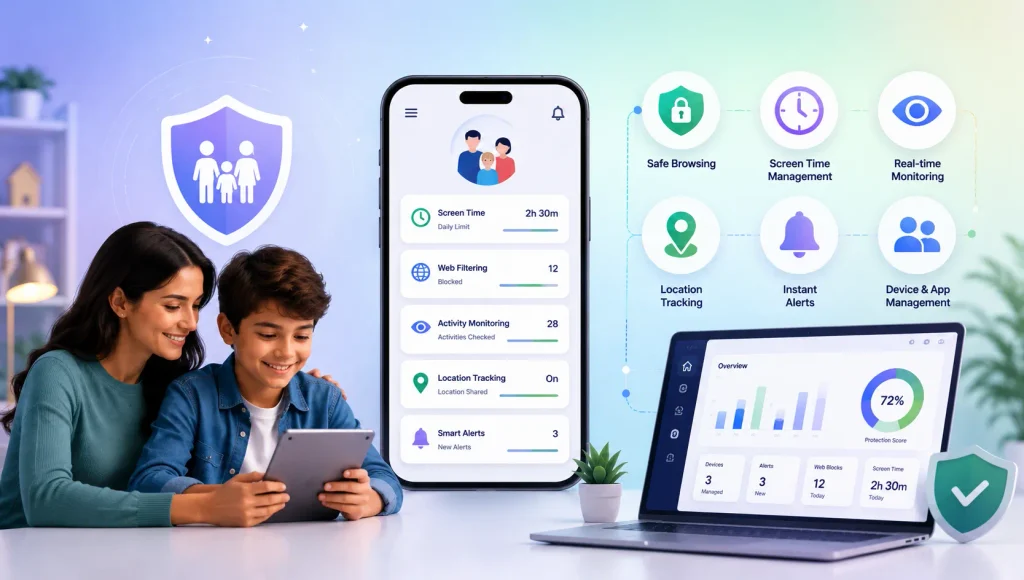
This is also where a dedicated parental control app earns its place. KidsNanny is built around exactly the kind of cross-device visibility TikTok’s own Family Pairing doesn’t reach — screen-time tracking across all apps and devices, content scanning for harmful keywords and images, and detailed reports that show parents which apps are eating the most attention. For a full walkthrough of TikTok-specific protections, see our guide on TikTok safety and parental controls for kids.
The Bottom Line
Federal health officials say social media is not sufficiently safe for kids. Pediatricians have published a specific framework for evaluating it. And the Pew data on teen TikTok use — 16% on it “almost constantly,” nearly half of all U.S. teens online “almost constantly” — explains why the question has moved from “should my teen use TikTok?” to “how do we structure their use so it doesn’t crowd out sleep, school, and time with the people who actually know them?”
You don’t have to ban TikTok to take it seriously. You do have to know what your teen is actually seeing on it — and talk about it.