


On June 10, 2026, the Minister of Canadian Heritage introduced Bill C-34, the Safe Social Media Act — and at its centre is a proposal that would make Canada one of the first countries in the world to set a minimum social media age of 16. If you’re a parent, the headlines may have raised more questions than they answered: Is this law now? Does it apply to my teen? Which apps are affected, and how would platforms even check a child’s age?
This guide breaks down what the bill actually proposes — using the Government of Canada’s own materials and Parliament’s text of the bill — when it might realistically take effect, why Canada is acting now, and the practical steps you can take today, long before any law forces the issue. The tone here is deliberately calm: there’s no need to panic, but there’s good reason to get ahead of it.
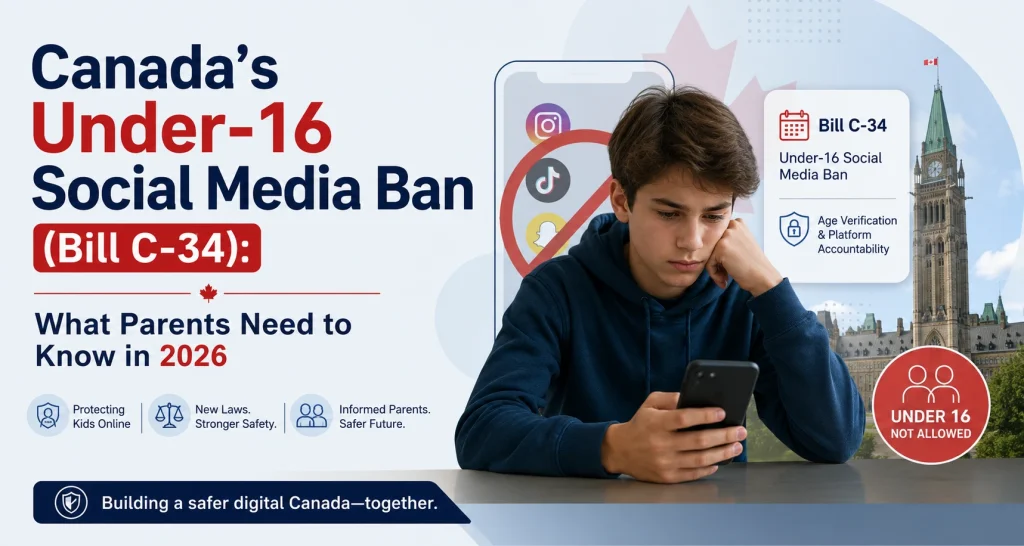
The short answer: No — social media is not banned for under-16s in Canada yet. On June 10, 2026 the government introduced Bill C-34, the Safe Social Media Act, which proposes a minimum social media age of 16, age verification for all users, new rules for AI chatbots aimed at kids, and a new Digital Safety Commission to enforce it. The bill is only at first reading — it still has to pass Parliament and clear regulations, so a realistic timeline for the rules actually applying to families is 2027 at the earliest. Nothing changes for your family today, but the best time to set healthy digital boundaries is now, not when a law forces it.
What Bill C-34, the Safe Social Media Act, Actually Proposes
According to the Government of Canada and reporting from CBC News, the bill is built around a few core ideas:
- A minimum age of 16. Regulated social media services would have to prevent anyone under 16 from creating or keeping an account.
- Age verification — for everyone, not just children. Because age-gating only works if a platform can tell a 15-year-old apart from a 25-year-old, operators would have to use adequate age-verification or age-estimation measures. In practice, that means every Canadian logging into a covered service could be asked to prove how old they are.
- It’s a ban with an off-ramp. This is the part many headlines miss: the new Digital Safety Commission could exempt a platform from the under-16 rule if that platform proves it has put sufficient safeguards in place for children. As CBC put it, the bill “gives platforms room to change.”
- A new regulator. The bill establishes a Digital Safety Commission of Canada to set standards, audit platforms, handle complaints from Canadians, and issue penalties.
Importantly, the bill does not spell out one fixed verification method. The government has signalled there will be a “back and forth” with platforms about what protects Canadians’ privacy while still being effective — whether that’s facial age estimation, ID checks, or another approach. Many of the practical details simply don’t exist yet.
What Counts as a “Regulated Service” — Including AI Chatbots
One detail surprised a lot of parents: the bill reaches well beyond ordinary social feeds. Its scope is broad enough to capture:
- mainstream social media services (the networks teens already use);
- user-uploaded livestreaming platforms;
- user-uploaded adult-content services; and
- in a Canadian first, AI chatbot services that are aimed at or accessible to children.
That last point matters. The government framed the legislation as making both “social media services and AI chatbots safer for children,” reflecting a year of growing alarm about AI companion apps. If you want to understand why regulators are nervous, our guide to how safe Character.AI and similar chatbots are for kids walks through the real risks — the same concerns now driving this law.
One nuance to hold on to: unlike Australia — which named ten specific platforms in its law — Bill C-34 names none. Coverage would instead be set later by regulation, based on a platform’s number of users and designation by the new Digital Safety Commission. Based on those criteria, large services such as Instagram, TikTok, Snapchat, X, YouTube and Reddit would very likely fall in scope — but the official list won’t exist until the regulations are written.
What Platforms Would Have to Do — and the Penalties
Beyond the age rule, regulated services would carry ongoing “duty of care” obligations. Under the Act they would have to:
- identify the risks of harm on their platform;
- adopt measures to address certain of those risks;
- build in safety-focused, age-appropriate design features;
- publish clear user guidelines and provide tools to block and flag content; and
- submit publicly disclosed digital safety plans.
The Digital Safety Commission would enforce all of this through reporting, audits, compliance orders and financial penalties. The numbers are large by design: administrative monetary penalties can reach the greater of $10 million or 3% of a company’s gross global revenue, and on indictment the maximum climbs to the greater of $20 million or 5%. Each day a violation continues can count as a separate violation. The legal community has published useful plain-language overviews of this structure, including BLG’s breakdown of the Safe Social Media Act.
When Would the Under-16 Rule Actually Take Effect?
This is the question that matters most for day-to-day parenting, and the honest answer is: not for a while. A bill being tabled is only the first step. As recorded on the Parliament of Canada website, Bill C-34 is currently at first reading. To become enforceable law, it must still:
- Pass three readings in the House of Commons
- Pass the Senate
- Receive Royal Assent
- Have detailed implementation regulations written and brought into force
A bill of this complexity and political weight typically takes many months to pass, and the regulations that follow Royal Assent add more time still. Legal analysts have noted that key details remain vague. A sensible expectation is that the under-16 rule would not actually apply to families until 2027 at the earliest — and possibly later. Like any bill, it could also be amended, delayed, or stalled along the way.
What this means for you: Don’t change anything in a panic. Your teen’s accounts aren’t disappearing this summer. Treat this as advance notice — a chance to start good habits early rather than scrambling later.
Why Now? Canada Is Joining a Global Wave
Canada’s move did not happen in isolation. Over the past year, a wave of countries has moved to restrict social media for minors, and Canada is following a path several others have already walked:
- Australia led the way: its under-16 ban took effect on December 10, 2025, covering platforms including Facebook, Instagram, Snapchat, Threads, TikTok, Twitch, X, YouTube, Kick and Reddit. By mid-2026, Australia’s eSafety Commissioner had opened formal investigations into several major platforms over compliance.
- Brazil tightened online protections for minors in March 2026.
- Indonesia and Malaysia introduced their own under-16 measures in the first half of 2026.
Inside Canada, the provinces have been moving too. Manitoba became the first Canadian province to announce a youth social media ban, and Ontario has publicly signalled it wants to crack down on technology use in schools. The federal bill effectively brings a national approach to a debate that was already happening province by province. For the fuller backstory on the law that started it all, see our breakdown of Australia’s under-16 social media ban, which is the template much of the world is now copying.
What It Means for Families — and the Concerns
Supporters argue that delaying social media until 16 gives children’s mental health, sleep and attention more room to develop, and shifts the burden of safety from exhausted parents onto the platforms that profit from young users. Critics raise real concerns too. Civil-liberties groups have warned that requiring everyone to verify their age creates new privacy risks — you can’t prove a teen is under 16 without also checking every adult — and that the bill’s vagueness leaves too much to future regulation.
For now, several key questions remain genuinely open:
- Which platforms are in scope? The final list will be set by regulation, not the bill itself.
- How will age be verified — and what happens to that data? The method is still being negotiated, and the bill allows exemptions only where data is used solely for verification and then destroyed.
- How will it be enforced, and will teens simply route around it with VPNs or borrowed logins? Australia’s early experience suggests enforcement is harder than passing the law.
The takeaway is not that the law will fix everything, and not that it’s meaningless — it’s that a law years away cannot protect your child today. That job still belongs to parents, and the good news is you already have the tools to do it. This is also a useful moment to revisit which platforms genuinely warrant caution; our guide to the social media apps that aren’t safe for kids is a practical starting point.
What Parents Can Do Right Now (Without Waiting for the Law)
Whether the rules arrive in 2027, later, or in a different form altogether, the healthiest digital habits are the ones you build now. Here are five steps that work regardless of what Parliament eventually passes — and they explain exactly why parental control tools have become essential for families in the first place.
1. Start the Conversation Early
Don’t wait for a ban to talk about it. Ask your child which apps their friends use, what they enjoy, and what makes them uncomfortable online. Explaining why a country like Canada would set an age limit — mental health, sleep, exposure to strangers, AI chatbots and harmful content — lands far better than a blanket “because I said so.”
2. Agree on Age-Appropriate Boundaries Together
Set clear, shared expectations: which apps are allowed at what age, where phones live at night, and what “too much” looks like. Boundaries that a child helps shape are boundaries they’re far more likely to keep. If overall screen time is the bigger battle in your home, our guide to managing and reducing your child’s screen time walks through realistic limits by age.
3. Use Device- and App-Level Controls
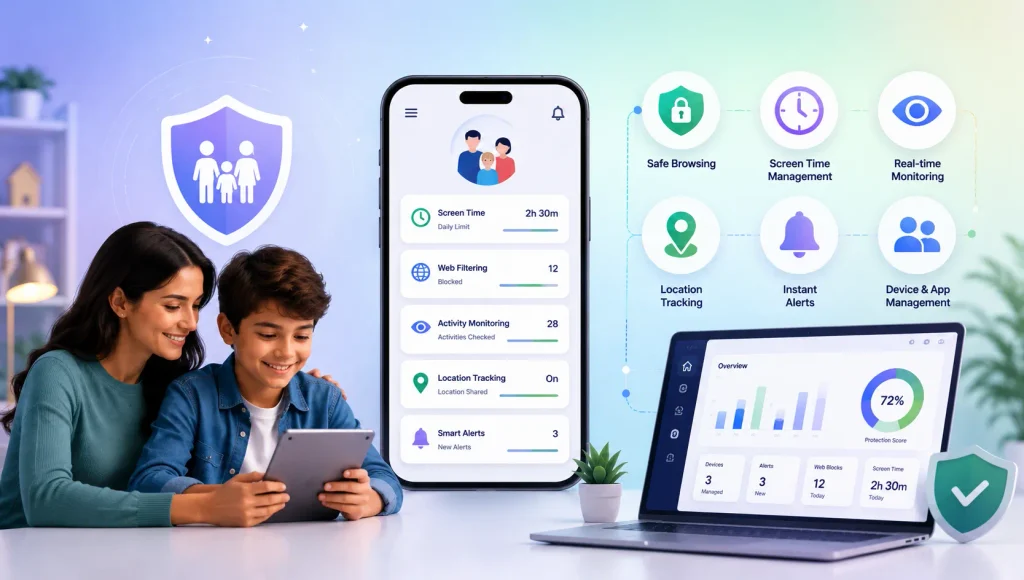
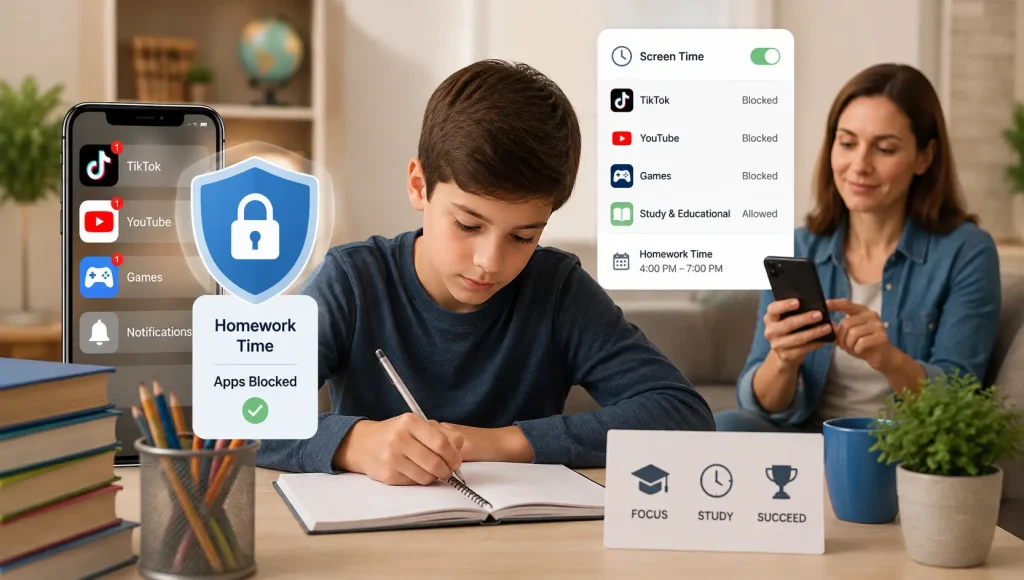
Built-in tools and dedicated apps let you put structure around the day — daily limits, bedtime schedules, and app-by-app rules. A tool like KidsNanny’s screen-time management works the same way across Android and iPhone, so the rules are consistent no matter which device your child is using.
4. Filter Content and Keep an Eye on New Apps
Age limits only matter if you know what’s actually on the device. Content filtering blocks harmful sites by category, while app blocking and new-install alerts let you know the moment a risky app appears — often the first sign a child is exploring a platform, or an AI chatbot, they’re not ready for.
5. Keep Location and Check-Ins Simple
Digital safety isn’t only about screens. Lightweight location awareness and check-ins give younger kids more independence while giving you peace of mind — especially over the summer and during the back-to-school transition.
None of this requires waiting for legislation. In fact, families who put these habits in place now will barely notice when — or if — the under-16 rules eventually arrive, because the structure will already be part of everyday life. You can compare plans on the KidsNanny pricing page, including a 7-day free trial with no credit card required.