




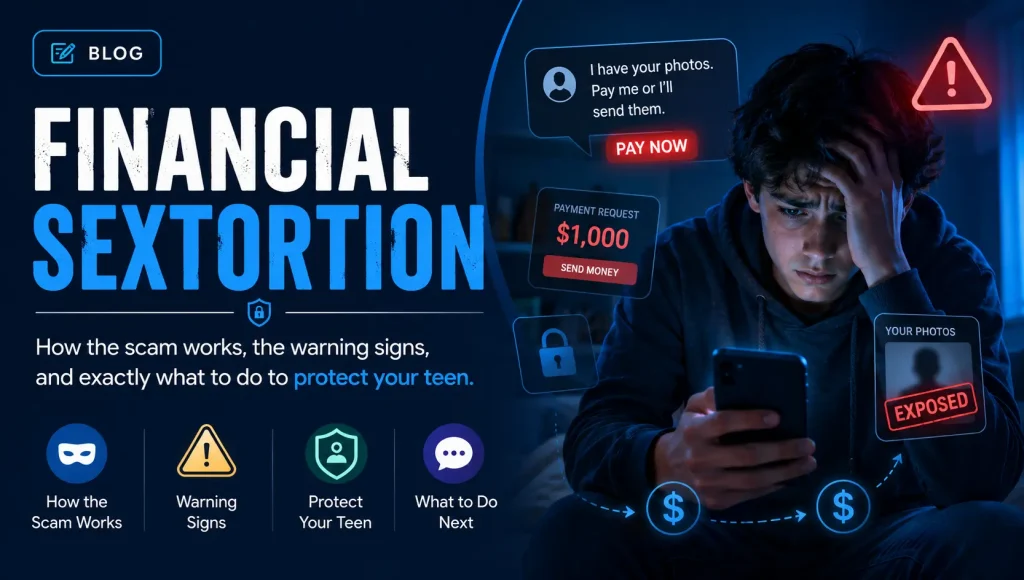
In the time it takes to read this article, another teenager somewhere will be targeted by a scam designed to terrify them into silence. It usually starts with a friendly, flattering message from someone who seems to be a peer — and within hours it can turn into threats, panic, and demands for money. This is financial sextortion, and it has become one of the most urgent online dangers facing young people today, especially teenage boys.
The good news is that it is also highly preventable, and it is survivable. Offenders rely on one thing above all else: a scared kid who feels too ashamed to tell anyone. When parents understand how the scam works and their teen knows in advance exactly what to do, that leverage disappears. This guide walks you through all of it — what financial sextortion is, who it targets, the warning signs, and a clear, step-by-step response if it happens to your child.
Key takeaways
- Financial sextortion tricks a teen into sending a sexual image, then demands money to keep it private.
- Roughly 90% of victims are boys aged 14–17, and LGBTQ+ youth are especially at risk of severe harm.
- It moves fast — offenders often demand an image and begin threats within hours of first contact.
- The response is simple to remember: don’t pay, don’t delete, preserve evidence, block, and report.
- Your child is a victim of a crime, never in trouble — saying this out loud, in advance, is powerful protection.
What Is Financial Sextortion?
Financial sextortion is a form of online blackmail. An offender poses as someone else — often an attractive teen or young adult — builds a quick connection with a young person, persuades them to send a sexually explicit photo or video, and then immediately threatens to send that image to the victim’s family, friends, and followers unless they are paid.
This is different from the sextortion of the past. Traditional sextortion was usually driven by a predator seeking more images or sexual contact. Financial sextortion is driven by money, and it is frequently carried out by organized criminal groups operating overseas who treat it as a high-volume business. According to the FBI, these schemes are financially motivated, fast-moving, and deliberately engineered to provoke panic so the victim pays before they think to ask for help.
Just How Common Is It?
The scale of this crime has grown at an alarming pace. The National Center for Missing & Exploited Children (NCMEC) reported receiving more than 50,000 reports of financially motivated sextortion in 2025 — an average of about 137 every single day. That is up sharply from roughly 36,000 reports the year before.
Behind those numbers are real families. In a national public safety alert, the FBI and its partners linked these schemes to at least 20 victim suicides over an 18-month period alone — a devastating reminder of how much terror these offenders manufacture in a matter of hours. Research from the anti-trafficking organization Thorn has documented the same trend: a sharp rise in financial sextortion, concentrated overwhelmingly on teenage boys.
If your child is in crisis right now: No image, no threat, and no amount of money is worth your child’s life. If your teen is having thoughts of self-harm, call or text 988 (the Suicide & Crisis Lifeline, available in both the U.S. and Canada) or go to your nearest emergency room. Reassure them that this problem has a solution and that you will face it together.
Who Is Being Targeted — and Why Boys?
While any young person can be a target, the data is striking: about 90% of detected financial-sextortion victims are boys between 14 and 17. LGBTQ+ young people are also especially vulnerable — Thorn’s research found they are roughly twice as likely to have an offender actually carry out their threats, and they report far higher rates of self-harm afterward.
Why teenage boys? Offenders exploit a specific combination of adolescent psychology: impulsivity, curiosity, a strong fear of social embarrassment, and a reluctance to admit they were fooled. A teenage boy who has just sent an image and is suddenly being threatened often feels a crushing wave of shame — and that shame is precisely the weapon the offender is counting on. Understanding this helps explain why so many victims pay or panic instead of telling a parent, and why the secrecy that surrounds teen online life can make the problem harder to spot.
How the Scam Works, Step by Step
Financial sextortion tends to follow a recognizable script. Knowing the pattern is one of the best ways to help your teen catch it early.
- The approach. A new account — often posing as an attractive girl of a similar age — sends a friendly or flirtatious message on a social media app, a game, or a messaging platform.
- The fast bond. The offender showers the teen with attention and compliments, moving quickly to feel like a real connection. They often push to switch to another app or to a more private chat.
- The bait. They send (or claim to send) an explicit image first, then pressure the teen to reciprocate. Sometimes they use a stolen or AI-generated photo to seem convincing.
- The trap springs. The moment an image is received, the tone flips. The offender reveals it was a setup and threatens to send the image to the teen’s followers, family, and school unless they pay — often via gift cards, payment apps, or cryptocurrency.
- The escalation. If the teen pays, the demands usually continue. If they freeze, the offender ramps up the pressure with countdowns and fake “proof” that they are about to expose them.
The whole cycle can be brutally fast. NCMEC warns that offenders often ask for an image almost immediately after following or friending a child, and the threats can begin within hours — leaving little time to recognize the danger. These offenders increasingly move the conversation onto encrypted or disappearing-message apps quickly, which is one reason anonymous and disappearing-message apps deserve extra attention from parents.
Where It Happens
Financial sextortion is not limited to one platform. Offenders go where teens are: mainstream social networks, direct messages, gaming chats, and video apps. Reports commonly involve Instagram, Snapchat, and other messaging and gaming services, with offenders steering victims toward more private channels as soon as possible. If your family uses platforms like Discord, it is worth reviewing the built-in privacy settings and reminding your teen that a stranger’s “friend request” is not the same as a friend.
Warning Signs to Watch For
There are two kinds of warning signs: the tactics offenders use, and the changes you may notice in your child. Teach your teen to be suspicious when an online contact does any of the following:
- Reaches out from a brand-new account with very few followers or posts
- Expresses strong romantic or sexual interest almost immediately
- Pushes to move the chat to another app or a private message right away
- Makes excuses to avoid turning on their camera or joining a live video call
- Sends an explicit image first and pressures your teen to send one back
And watch for these shifts in your own child, which can signal that something is already wrong:
- A sudden spike in anxiety, secrecy, or withdrawal
- Becoming visibly distressed after using their phone
- Deleting apps or messages, or being unusually protective of their screen
- Requests for money or unexplained spending, gift cards, or transfers
Because so much of this happens out of sight, some parents choose to use tools that flag concerning contacts or content — for example, KidsNanny’s Screen Scanner, which is designed to help surface signs of grooming and sextortion before they escalate. Monitoring is not a substitute for conversation, but it can buy precious time.
What to Do If It’s Happening to Your Child
If your teen comes to you, or you discover this is happening, the most important thing is to stay calm. Your child is frightened and ashamed; your steadiness tells them the situation is fixable. Then follow these steps.
Do NOT pay. The FBI and NCMEC are clear on this: paying rarely stops the threats and almost always leads to more demands. Even if some money has already been sent, stop now — you can still cut off the offender’s leverage.
- Stop all contact — but don’t delete anything yet. Tell your teen not to reply, pay, or send further images. The evidence in those messages is what helps investigators.
- Preserve the evidence. Take screenshots of the offender’s profile, username, and the full conversation, including any payment details. Save it somewhere safe before you touch the account.
- Block and report the account on the platform. After preserving evidence, block the offender and report the profile to the app so it can be taken down.
- Report it to the authorities. In the U.S., file a report with NCMEC’s CyberTipline (or call 1-800-843-5678) and the FBI at ic3.gov. In Canada, report to Cybertip.ca, the national tipline, and contact your local police.
- Get the images taken down. Use Take It Down, a free NCMEC service that assigns a digital fingerprint to the image so participating platforms can detect and remove it. In Canada, NeedHelpNow.ca helps youth remove sexual images and videos.
- Support your teen. Reassure them repeatedly that they are not in trouble and that this happens to many smart, careful kids. If they are struggling emotionally, reach out to a counselor or call 988.
A note on shame: Offenders win by convincing a child that telling a parent is the worst possible outcome. The truth is the opposite — the moment a trusted adult is involved, the threat begins to lose its power. Make sure your teen hears this from you before they ever need it.
How to Protect Your Teen (Before It Happens)
Prevention is far less about surveillance than about preparation. The families most protected against this crime are the ones who have talked about it openly.
1. Have the conversation early — and without judgment
Explain what financial sextortion is in plain terms, and make one message unmistakable: “If anyone ever pressures you for a photo, or threatens you over one, come to me. You will not be in trouble — we’ll fix it together.” A teen who believes that is dramatically harder to blackmail.
2. Teach the red flags
Help your teen internalize the warning signs above, especially the fast romantic interest, the push to a private app, and the refusal to appear on camera. Normalize the idea that a stranger online is a stranger, no matter how friendly.
3. Lock down privacy settings
Set social accounts to private, limit who can send direct messages, and turn off location sharing. Fewer open doors means fewer opportunities for a first contact. Our guide to deciding when a child is ready for a smartphone covers how to pair new devices with the right guardrails from day one.
4. Keep an open line, not just an eye
Regular, low-pressure check-ins about online life do more than any single rule. Combine that trust with practical safeguards — parental controls, content alerts, and honest talks about the risks of sharing images — so your teen has both a safety net and someone to run to.
The Bottom Line
Financial sextortion is frightening precisely because it is designed to be. But it runs on secrecy and shame, and both of those collapse the instant a young person tells a trusted adult. You do not need to be a cybersecurity expert to protect your child — you need to make sure they know this scam exists, know they can always come to you, and know that the answer is never to pay, but to preserve, block, and report. Have that conversation this week. It is one of the most protective things you will ever say to your teen.