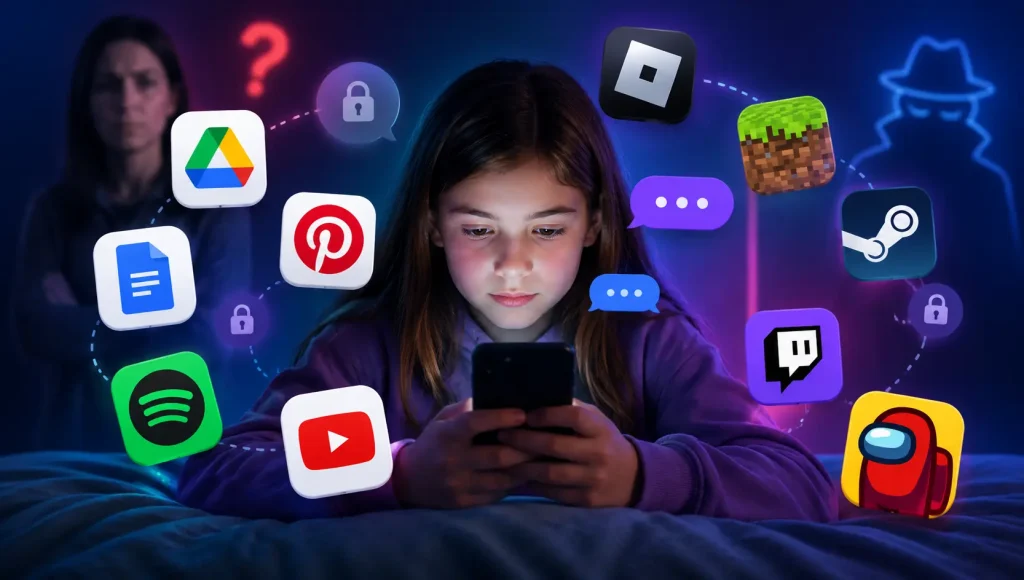



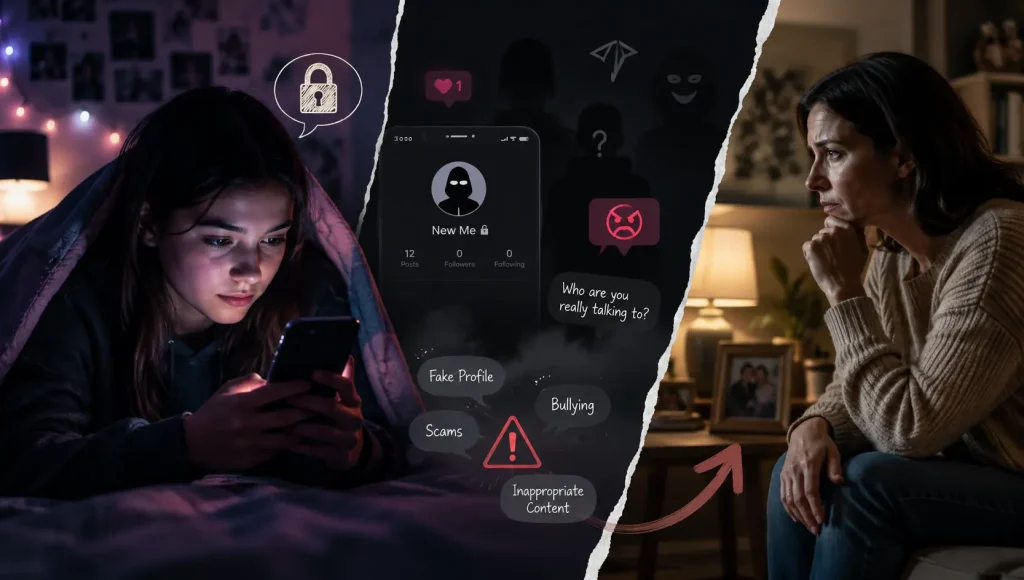
Many parents are surprised to discover that their children may be using more than one social media account. Alongside their main Instagram, TikTok, or Snapchat profiles, some teens create secondary or “hidden” accounts — often called Finsta (Fake Instagram), spam accounts, or private profiles.
These accounts are not always harmful. In fact, research suggests many teens use them for privacy, self-expression, and communicating with a smaller group of trusted friends. However, they can also make it harder for parents to understand their child’s online experiences and identify potential risks.
Understanding why teens create these accounts is an important part of modern digital parenting. Parents who are already working on healthy screen time habits for kids and teens may notice that hidden accounts are often connected to the same broader online privacy concerns.
What Are Secret or “Finsta” Accounts?
A Finsta (short for “Fake Instagram”) is a secondary social media account used by teens to share content with a smaller audience.
Unlike a main account, a Finsta often includes:
- close friends only
- more personal content
- private jokes and conversations
- day-to-day thoughts and feelings
Research published in the Journal of Computer-Mediated Communication found that teens often create multiple accounts to manage different audiences and maintain greater control over their online identity.
Why Do Kids Create Secret Social Media Accounts?
1. Privacy and Control
One of the biggest reasons teens create secondary accounts is privacy. Many young people want a space where they are not constantly observed by parents, teachers, relatives, future employers, or large follower groups.
Research shows teens actively use privacy tools and multiple accounts to manage who can see specific content.
2. Pressure From “Perfect” Social Media
Many teens feel pressure to maintain a polished online image on their public accounts. Private accounts allow them to:
- be more authentic
- share mistakes
- discuss emotions
- post without worrying about likes
Studies suggest that many teens separate their “public identity” from their “private identity” online.
3. Staying Connected With Close Friends
For some teens, a secret account is simply a smaller digital space shared with trusted friends — used for group humor, inside jokes, personal conversations, and emotional support. The same instinct drives teens toward teen chat rooms and other small-group spaces where the audience feels manageable. This type of behavior is not necessarily dangerous and can be part of normal adolescent social development.
4. Avoiding Judgment
Teenagers often feel pressure from social media algorithms and peer expectations. Secondary accounts can reduce social anxiety, popularity pressure, and follower comparisons — giving teens a space that feels more private and less performative.
5. Audience Separation
Researchers call this “context collapse” — when multiple audiences (parents, friends, teachers, coaches, relatives) all exist in the same space. Creating separate accounts allows teens to control who sees what. This pattern is documented in the Journal of Computer-Mediated Communication.
Are Secret Accounts Always Dangerous?
No. Research does not suggest that all hidden accounts are harmful. Many are used for privacy, self-expression, close friendships, and identity exploration.
However, risks increase when:
- strangers gain access
- cyberbullying occurs
- inappropriate content is shared
- privacy settings are ignored
Parents who are already concerned about anonymous chat apps and the safety risks they pose for kids will notice many of the same privacy challenges show up inside private social media spaces — just inside platforms that look more familiar from the outside.
Risks Parents Should Understand
1. Reduced Visibility
Parents may only see a child’s public account while important interactions occur elsewhere — on secondary accounts, in private group chats, or inside close-friends-only feeds. It’s also worth knowing the adult social media apps kids definitely shouldn’t be on, since hidden profiles sometimes act as a quiet gateway into platforms parents weren’t expecting their child to use at all.
2. Cyberbullying in Private Spaces
Private accounts and group chats can sometimes become environments for exclusion, gossip, bullying, and peer pressure. This is one reason experts encourage open communication rather than relying solely on monitoring tools — families who have already talked about how cyberbullying affects kids and teens generally find it easier to raise the same questions about private accounts.
3. Privacy Misunderstandings
Many teens believe private accounts are fully protected. In reality:
- screenshots can be taken
- content can be shared
- accounts can be hacked
Teaching privacy awareness remains critical.
4. Contact With Strangers
While many secret accounts remain private, some may attract unknown followers. Parents should discuss follower requests, fake profiles, scams, and the early signs of online grooming and sextortion every parent should know — the same warning signs apply just as much inside a hidden account as anywhere else online.
What Parents Should NOT Do
Avoid these reactions
- Immediately banning social media
- Accusing children of hiding dangerous behavior
- Secretly spying without communication
Research consistently shows that fear-based responses often encourage greater secrecy — not less.
How Parents Can Respond
1. Build Open Conversations
Instead of asking “Why are you hiding things from me?”, try a curiosity-first opener:
“Many teens use multiple accounts. Can you help me understand how you use yours?”
2. Focus on the Reason Behind the Account
Most teens create secondary accounts because of privacy, self-expression, and audience control. Understanding the reason is often more important than the account itself.
3. Teach Digital Privacy
Help children understand:
- nothing online is completely private
- screenshots are permanent
- personal information should be protected
Parents teaching digital literacy may also find value in extending the same conversation to protecting kids from ChatGPT and other AI tools, since privacy, identity, and online trust are closely connected across all of these spaces.
4. Set Family Digital Rules Together
Create expectations around followers, posting behavior, privacy settings, and stranger interactions. Collaborative rules are usually more effective than strict restrictions — and they work best when paired with a few practical safeguards underneath, such as knowing how to block Pornhub and other adult content across the household’s devices so the privacy conversation rests on a concrete safety floor.
5. Stay Involved Without Becoming Controlling
The goal is not complete surveillance. The goal is helping children make safer choices, recognize risks, and build healthy online habits.
Final Thoughts
Secret social media accounts are becoming increasingly common among teens. While they may sound alarming, research shows that many are simply tools for privacy, self-expression, and managing different social groups.
Parents do not need to panic. The most effective approach is open communication, digital education, privacy awareness, and healthy online boundaries.
When parents understand why these accounts exist, they are better equipped to support safe and responsible digital habits.