


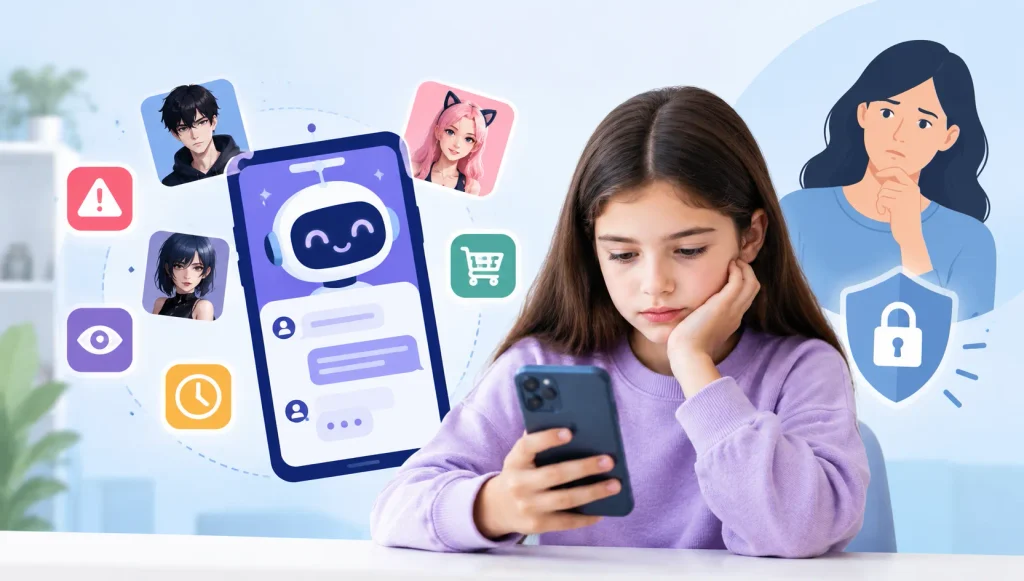
AI character and companion apps are becoming increasingly popular. Instead of simply asking AI questions, users can have ongoing conversations with fictional characters, create their own personalities, and use AI for storytelling and roleplay.
One of these platforms is PolyBuzz, an AI character chatbot available on mobile devices and through the web.
But is PolyBuzz safe for kids?
No. PolyBuzz’s current Terms of Use state that users must be at least 18 years old, and that its services are prohibited for anyone under 18 worldwide.
There is an important detail parents should know: PolyBuzz’s FAQ currently describes a “Teen Mode,” while its Terms of Use and Privacy Policy state that users under 18 are not permitted to use the service. Because these statements do not fully align, parents should rely on the platform’s current legal age requirement rather than assuming a teen-related setting means children are allowed to use PolyBuzz.
Here’s what parents should know about PolyBuzz and the broader risks of AI companion apps.
What Is PolyBuzz?
PolyBuzz is an AI character chatbot platform where users can chat with AI-generated characters, create their own characters, and participate in roleplay conversations.
PolyBuzz currently says its platform has more than 20 million AI characters. Users can choose existing characters or create their own personalities, stories, appearances, and other characteristics.
The platform also promotes AI companions such as virtual friends, boyfriends, and girlfriends, as well as roleplay and voice-based interactions.
For adults, these can be entertainment features. For children and younger teenagers, however, AI companion platforms can create additional concerns because conversations can become personal, emotionally engaging, or inappropriate.
Is PolyBuzz Allowed for Kids?
No. PolyBuzz’s current Terms of Use require users to be at least 18 years old. The Terms state that PolyBuzz services are strictly prohibited for minors under 18 worldwide.
PolyBuzz also says users must provide their date of birth when first using the service. In the UK, PolyBuzz says users must complete an age verification check with third-party providers before accessing the service, to comply with the UK’s Online Safety Act.
At the same time, PolyBuzz’s FAQ currently mentions a Teen Mode and describes it as being designed for children.
That creates an important distinction for parents:
The existence of a Teen Mode does not override PolyBuzz’s current Terms of Use. The stated minimum age is 18.
Google Play currently lists PolyBuzz as Mature 17+, while Apple’s App Store lists it as 18+ and identifies mature or suggestive themes, sexual content or nudity, messaging/chat, user-generated content, and in-app purchases among its app information.
For parents, the platform’s own 18+ Terms are the clearest reason not to allow a child to use PolyBuzz.
What Are the Risks of PolyBuzz for Kids?
1. Sexual and age-inappropriate content
PolyBuzz says that public NSFW content is prohibited and that recommended content is subject to AI screening and human moderation.
However, the platform also states on its AI girlfriend page that NSFW filters are not applied during private chat sessions, allowing unrestricted or “spicy” roleplay conversations.
This is particularly important for parents.
A child may start with an apparently harmless character but move into a private conversation involving romantic, sexual, or otherwise mature themes.
Because PolyBuzz is an 18+ service, parents should not rely on its public-content moderation as evidence that the overall experience is appropriate for children.
2. AI companions can create emotional attachment
AI characters are designed to keep conversations going. They can respond immediately, adopt different personalities, remember parts of conversations, and simulate friendship or romantic relationships.
This can make an AI character feel more personal than a traditional website or game.
Common Sense Media’s Youth AI Safety Institute currently rates social AI companions as an unacceptable risk for children and teens under 18. Its assessment highlights emotional attachment and dependency, inappropriate content, harmful behavior, and the difficulty some young users may have maintaining healthy boundaries between AI relationships and real relationships.
This does not mean every child will become emotionally attached to an AI. The concern is that the design of social AI companions can make that type of relationship particularly engaging for young users.
3. Children may share personal information
AI conversations can feel private and informal, which may encourage children to share information they would not normally post publicly.
A child might tell an AI character their:
- Real name
- School
- Location
- Family situation
- Personal problems
- Relationship concerns
- Private thoughts
Common Sense Media’s research found that some teen AI companion users report sharing personal or private information with AI companions.
Parents should teach children that an AI chatbot is still a technology service and that personal information should be treated carefully.
A simple rule can help: If you would not share it with someone you don’t know online, don’t share it with an AI companion.
4. AI conversations can provide harmful responses
AI systems can generate responses dynamically, which means parents cannot assume that every conversation will remain within the same topic or tone.
Research into social AI companions has found examples of systems providing inappropriate sexual content, encouraging harmful behavior, and giving dangerous information.
This is one reason Common Sense Media recommends that social AI companions should not be used by anyone under 18.
5. Excessive use can become a concern
Unlike a video or article that eventually ends, an AI conversation can continue indefinitely.
There is always another message, another response, or another character to interact with.
For some young users, this can make it difficult to stop using the service and can compete with sleep, schoolwork, family time, hobbies, and real-world relationships.
Parents should therefore consider both what their child is doing online and how much time they are spending on it.
6. In-app purchases can add another risk
PolyBuzz is available for free but also offers memberships and in-app purchases. Google Play currently identifies the app as containing ads and in-app purchases, while Apple’s listing includes multiple paid plans and virtual coin purchases.
Parents should review payment settings on devices used by children and prevent unauthorized purchases.

How Can Parents Keep Kids Safe From AI Chatbot Risks?
1. Talk openly about AI companions
Your child may encounter AI companion apps through social media, friends, online advertisements, or other apps.
Explain that:
- AI characters are not real people.
- AI can make mistakes or produce inappropriate responses.
- Children should not share private information with AI.
- AI should not replace trusted adults or real-world friendships.
- They should tell you if an AI conversation becomes sexual, threatening, frightening, or uncomfortable.
Keep the conversation calm rather than treating curiosity about AI as something to punish.
2. Check which AI apps are installed
Review the apps on your child’s phone, tablet, and computer.
Pay particular attention to:
- AI companion apps
- Character chatbot apps
- Anonymous chat apps
- Apps with mature age ratings
- Apps with in-app purchases
- Recently installed applications
If an app is prohibited for users under 18, such as PolyBuzz under its current Terms, blocking or removing it is the simplest approach. Because PolyBuzz also works in a web browser, block the polybuzz.ai website too.
3. Use app blocking and screen-time controls
Parental controls can help turn family rules into practical restrictions.
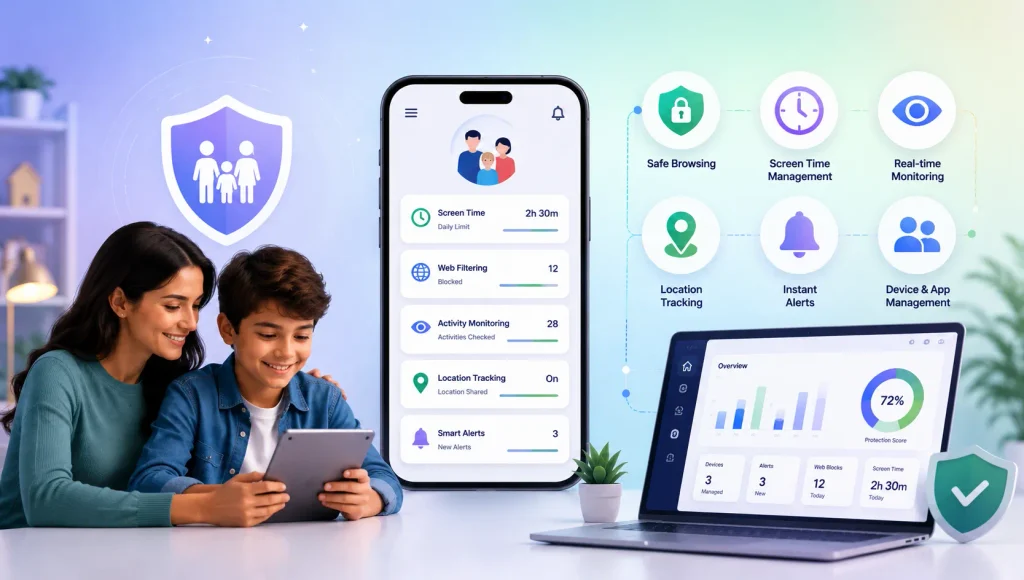
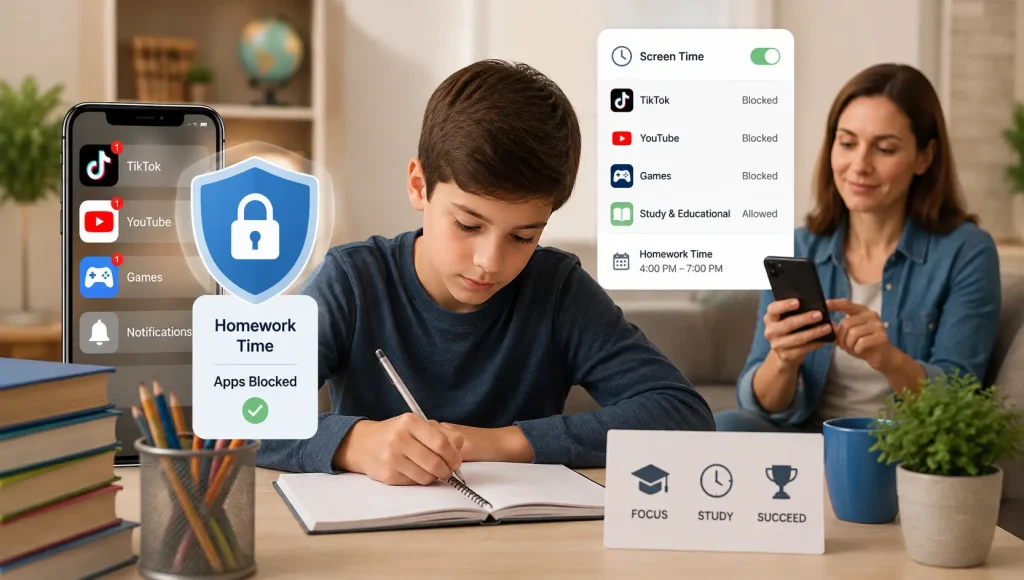
KidsNanny lets parents block individual apps or categories, block websites such as polybuzz.ai with Content Filter, set screen-time limits, and schedule downtime on a child’s device.
This can be useful when parents want to prevent access to an unsuitable AI companion app rather than relying only on a child remembering the family rule.
4. Monitor for harmful content
Screen-time reports can tell you how long a child used an app, but they don’t necessarily tell you what appeared on the screen.
KidsNanny’s AI Screen Scanner is designed to periodically analyze a child’s screen and alert parents when potentially harmful or age-inappropriate content is detected.
It can provide an additional layer of visibility alongside app blocking, web controls, and screen-time management.
No automated safety system should be treated as perfect, so parents should still combine technology with regular conversations and supervision.
5. Create family rules for AI use
A simple family AI agreement can establish clear boundaries.
Consider agreeing on:
- Which AI apps children can use
- Which apps are not allowed
- What personal information must remain private
- When AI can be used
- How much time can be spent using it
- What children should do if an AI produces inappropriate content
- When they should immediately tell a parent
The goal is not to make children afraid of AI. It is to help them understand its limitations and use technology responsibly.
What If Your Child Is Already Using PolyBuzz?
If you discover PolyBuzz on your child’s device, try not to react with anger or embarrassment.
Start by asking what they were using it for and whether they encountered anything that made them uncomfortable.
You can then:
- Explain that PolyBuzz’s current Terms require users to be 18 or older.
- Ask whether they encountered sexual, violent, frightening, or otherwise inappropriate conversations.
- Remind them not to share personal information with AI systems.
- Remove or block the app, and block the polybuzz.ai website.
- Review other AI companion and chatbot apps on the device.
- Set appropriate app and screen-time restrictions.
- Encourage your child to tell you if they encounter something disturbing online.
A child should feel comfortable telling a parent about an inappropriate AI conversation without worrying that they will automatically be punished for reporting it.
Is PolyBuzz Safe for Kids? Final Verdict
No. PolyBuzz is not appropriate for children under 18.
The clearest reason is its current Terms of Use, which state that users must be at least 18 and that the service is prohibited for minors worldwide.
The platform’s AI character and companion features also create concerns around mature content, private conversations, emotional attachment, privacy, excessive use, and potentially harmful AI responses.
PolyBuzz does have content moderation for public and recommended content, but its own website states that NSFW filtering is not applied to private chat sessions.
More broadly, child-safety researchers have identified significant risks associated with social AI companions and recommend that these services not be used by children and teens under 18.
For parents, the best approach is to combine clear age-appropriate rules, open conversations, app blocking, screen-time management, and visibility into potentially harmful content.
AI can be a useful technology, but an AI character is not a friend, parent, counselor, or trusted adult.